Rethinking Your 2027 Benefits Strategy Before Renewals


Key Takeaways
- Mid-year data shows most employers running over budget, and one in four now faces a renewal of 15% or more.
- Benefits consultants from Alliant and Lockton agree the usual response of shifting costs to employees is used up, because families’ medical exposure has caught up to their savings.
- Employers can still act for 2027 by steering members to individual high-quality doctors, and one panelist rolled that strategy out for clients as late as September and October last year.
To hear the full conversation, watch the webinar.
Employer medical trend is running near 9% this year, close to a 17-year high, and 2027 renewals are landing on desks right now. That urgency shaped our recent webinar, The Mid-Year Pivot: Rethinking Your Benefits Strategy Before You Finalize 2027, where I sat down with two benefits consultants who spend every day inside these renewal conversations: Larry Chim (Senior Vice President, Employee Benefits at Alliant Insurance Services) and Kristoffer Osea (Senior Vice President at Lockton).
Based on their experiences, both of them landed on the same two conclusions. The old playbook of passing increases along to employees is used up, and what still works is guiding people to specific high-quality doctors, not changing networks or carriers. The good news is it’s not too late. Employers can still make almost every move we discussed before they finalize their 2027 plans.
The over-budget year that employee health can’t explain
When we polled the audience on where 2026 costs are landing against budget, over budget was the clear leader at 52%. And that’s not a problem caused by inexperience. Chim sees the same pattern across Alliant’s book. Clients are getting hit with unexpected increases, and Chim says an employer running close to budget “continues to be the exception rather than the rule.” In Garner’s data, roughly 6 to 10% of clients faced a renewal of 15% or more for most of the past decade. That share has now surged past 25%, meaning one in four employers are seeing these giant renewals.
Holding age constant, rates of asthma, diabetes, and cancer have been flat for a decade. This isn’t a health problem. It’s a cost problem, driven by four structural forces of roughly the same size. Hospitals raised prices as systems consolidated, adding about two points of trend. Pharmacy adds another 1.8 points through specialty drugs and GLP-1s. Doctors delivering care that deviates from clinical guidelines add more through complications, revisions, and unnecessary procedures. And AI-assisted coding now produces bigger bills for the same care.
The GM chart every CFO should see
None of those four drivers is slowing down, and one American company already showed what happens when costs like these pile up year after year. Warren Buffett once described GM as a huge annuity and health insurance company with a major auto company attached to it. By 2008, nearly 9% of GM’s revenue was going to pension costs, much of it medical, and the next year brought bankruptcy, restructuring, layoffs, and a government bailout. In the session, I put GM’s curve next to Garner’s data on what labor-intensive employers now spend on healthcare as a share of revenue. The shape is the same, and on the current trend the average employer crosses GM’s 9% mark around 2030 or 2031. Not every company is heading for bankruptcy, but healthcare has quietly become the kind of structural cost that helped take down one of America’s biggest companies, and every renewal cycle an employer waits, the hole gets deeper.
Why the standard lever no longer works
For years, the answer to a bad renewal was to raise the deductible and the out-of-pocket max and pass the increase along. That lever is functionally used up. The average family’s liquid assets and their potential medical out-of-pocket costs have converged. You can’t shift what people don’t have. Chim calls the result a crisis of members being “functionally uninsured,” yet he still watches employers reach first for contribution increases and deductible hikes “because those things are easily understood.” His argument is that those moves should be “a last line of defense against other proactive measures rather than the first default response.”
Osea sees the same tension from the talent side, because blunt instruments “contribute to the erosion of the overall value proposition of the benefits program” at the exact moment HR teams are fighting to recruit and retain. Finance teams are watching more closely too. “I’ve never seen finance be more involved in renewal discussions than I have been over the past couple of years,” Chim says, “and I expect that will continue to be the case.”
Paying more doesn’t buy better care
Employers have tried plenty of other levers, but they all share a problem. Narrow networks, carrier shopping, and wellness programs all work on the network or the plan, not on where care actually happens. And a discount off an inflated charge is still an inflated charge.
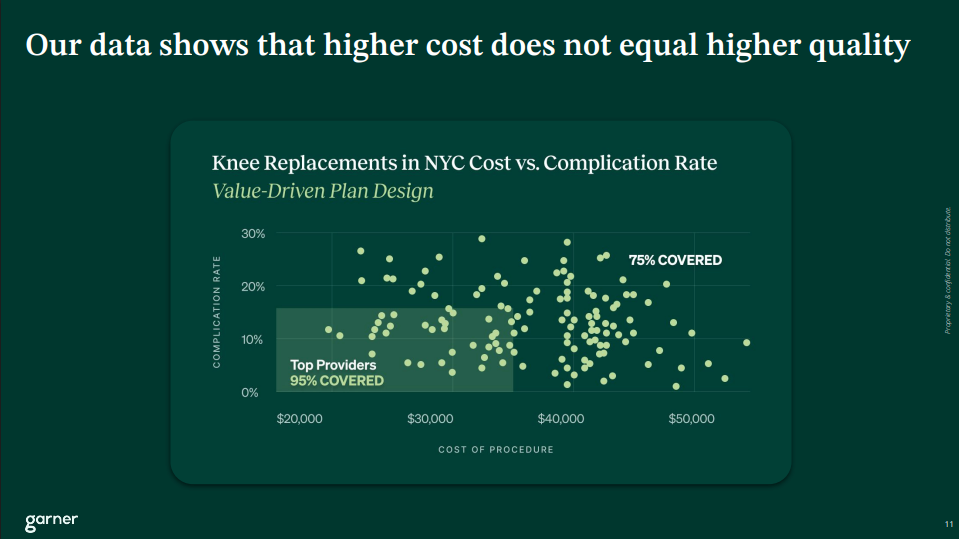
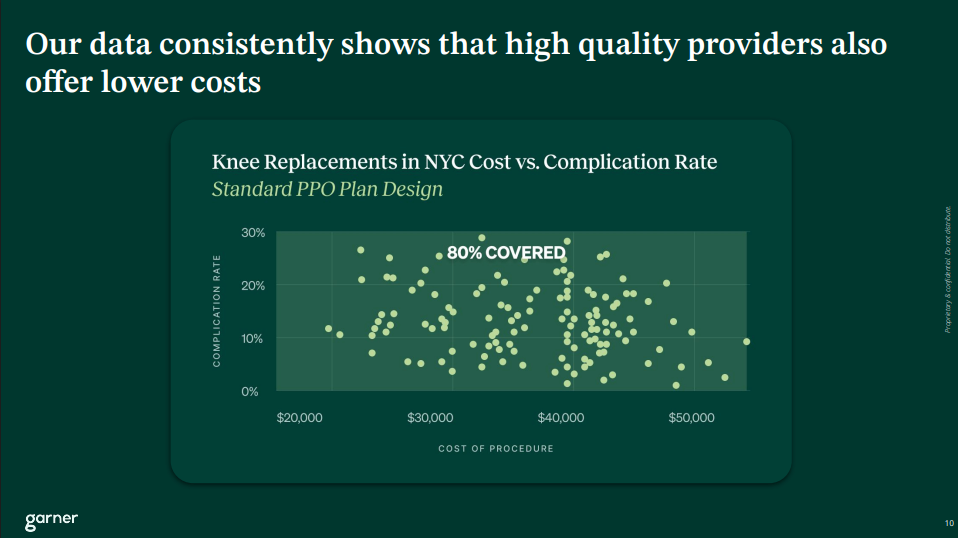
To show what those strategies are missing, I shared claims data on every surgeon performing knee replacements in New York City, plotted by price against complication rate. Prices run from $20,000 to over $50,000, but the data shows the expensive surgeons are not always the better ones. Some of the best outcomes in the city come from surgeons in the mid-$20,000s, while some of the worst come from surgeons charging more than $40,000. A standard PPO covers every one of them at the same 80%, so whether your employee lands on a great surgeon or a terrible one is essentially by chance, and you’re paying the difference either way.
Both consultants say employers rarely believe this at first. “It’s met with a fair bit of skepticism,” Osea says, “because who are we as an employer or as a consultant to say that Dr. Smith or Dr. Jones is better than this other doctor, even though I’ve been going to them for 10-plus years.” But showing the variation changes the conversation. Chim says it “really allows us to shift the conversation from one that’s focused on unit cost and discounts into one that’s focused on how do you make your ecosystem more efficient.”
The window for 2027 is still open
The alternative we walked through is value-driven plan design. Identify the doctors who deliver better outcomes at lower cost, cover visits to them at 95% while everyone else stays at 75%, and let members keep their full network. Nobody is restricted, but the smart choice becomes the cheapest choice. And for anyone staring at a tough renewal, the most useful part of the session may be the timeline.
Osea rolled out Garner for one Lockton client with a decision date in mid-September last year and for another in October. Neither required a carrier change or any plan design changes, and after a slow start, word of mouth pushed utilization to 50% of members at one client and upwards of 75% at the other, alongside what he calls “pretty impressive results and cost avoidance.”
The mid-year pivot is toward steering, not shifting
Moderating the discussion, what struck me was how quickly two consultants from different firms and very different client bases landed in the same place. The solution is to stop treating cost shifting as the first move, and put the plan’s money behind the doctors who actually deliver better care. Use the months before January to act instead of letting another renewal force the issue.
I enjoyed hosting this discussion and want to thank Larry and Kris for sharing their expertise with us. The full webinar also covers how the panel holds carve-out vendors to performance guarantees with real teeth, and where advanced primary care fits into a 2027 strategy.
Watch the full session to hear it in their own words.
Want to learn more about our upcoming webinars? Visit our Webinars page to sign up.