The Biologic Problem: A Case Study on Skyrizi & Tremfya
Why are employers paying nearly six times more for biologics that barely outperform a Humira biosimilar?
The impact of Skyrizi and Tremfya alone is enormous: the two drugs increased employer healthcare expenditures by over 1% last year and are continuing to gain popularity. Pharmaceutical pricing and distribution dynamics have made the obvious remedies, changing formularies and sourcing through lower-cost pharmacies, minimally effective. As we worked through every lever available to employers today, we found only one holds significant promise: giving patients the incentive to see high-value doctors.
Skyrizi and Tremfya cost nearly 6x more than a Humira biosimilar
Skyrizi and Tremfya treat the same diseases as Humira, a drug that has been on the market for more than two decades and now has low-cost biosimilars. The difference is price: they cost about $100,000 a year, compared with about $17,000 for a Humira biosimilar.
The results are nearly the same. In psoriatic arthritis, 60% of patients on Skyrizi or Tremfya see at least a 20% improvement in joint symptoms after six months, compared with 57% on a Humira biosimilar. In Crohn's disease, 50% stay in remission, compared with 45%. For these conditions, employers are paying about $80,000 more per patient a year so that three to five more patients out of every 100 respond to treatment.
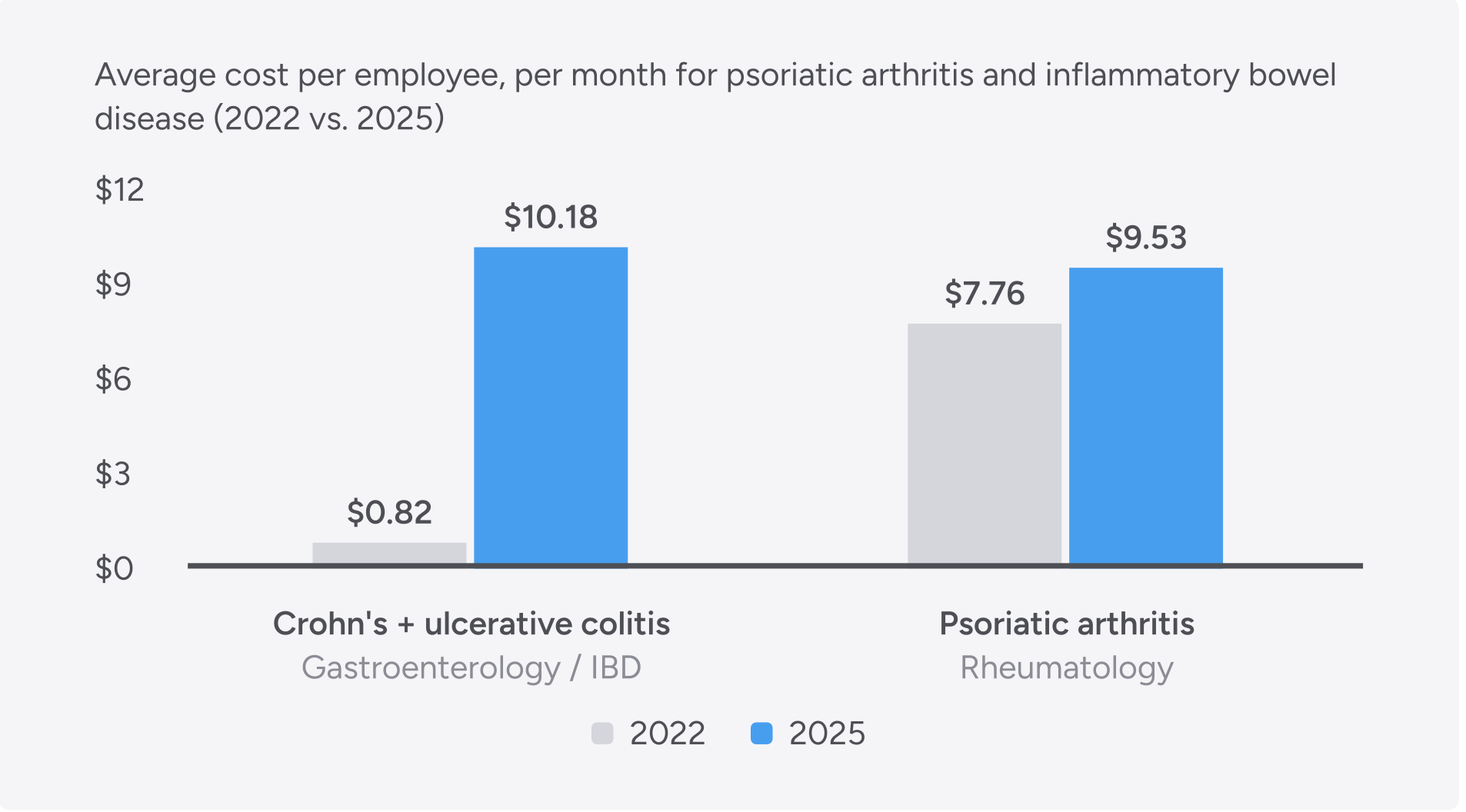
Despite these results, prescriptions have moved to the branded drugs. For these two conditions alone, Skyrizi and Tremfya spending went from about $9 to nearly $20 per employee per month between 2022 and 2025.
Many patients would try less expensive treatments first if they kept even a fraction of the resulting savings. Unfortunately, the healthcare industry has made such consumerism nearly impossible. Manufacturer “Patient Assistance Programs” erase the copay on the expensive drug, which removes any reason to try the cheaper one first, while employers remain on the hook for the full cost.
Benefits leaders have three levers to reduce drug spend without making groundbreaking drugs unavailable: 1) formulary and pharmacy benefit manager (PBM) changes, 2) discount pharmacies, and 3) doctor steerage. Only one of them works.
Formulary changes barely move prescribing
The first lever is to mandate step therapy: requiring a patient to try more cost-effective treatment options before the plan will pay for the expensive one. Some plans do mandate it, but doctors and patients who want the expensive drug can work around it. Step therapy mandates reduce Skyrizi and Tremfya prescribing by only 2 to 5 percentage points.
Cheaper pharmacies are off the table
U.S. discount pharmacies cannot help here: Cost Plus Drugs does not stock Skyrizi, and GoodRx offers only marginal discounts, if any. International pharmacies, on the other hand, do sell Skyrizi for a fraction of the U.S. domestic price. The challenge, however, is that the pharmaceutical manufacturers have managed to make the international option effectively off-limits for commercial plans, winning a number of recent injunctions against this very practice.
The doctor a patient sees makes a 34- to 40-point difference
The decision that matters most sits where it always has, with the prescriber. For both psoriatic arthritis and inflammatory bowel disease, lower-value doctors start patients on the expensive drug at nearly three times the rate of high-value doctors.
The difference comes from how these doctors practice, not which patients they see: lower-value doctors start far more patients on Skyrizi or Tremfya without first trying a less expensive treatment. That first prescription matters: because the cheaper therapies are nearly as effective, patients who start on them are much less likely to end up on Skyrizi or Tremfya at all.
These high-value doctors already exist, and their behavior doesn’t need to change. Employers that give members a reason to see those doctors can lower biologic spend now, without waiting on formulary or pharmacy changes, and without giving up the outcomes these drugs make possible.
Inside The Biologic Problem:
- How often lower-value and high-value doctors start new patients on Skyrizi or Tremfya, broken out for psoriatic arthritis and inflammatory bowel disease
- How a plan can use the same copay approach as Patient Assistance Programs to get members to high-value doctors
- How far step therapy could cut prescribing if doctors followed it in good faith
- The full cost and effectiveness comparison of conventional treatments, Humira biosimilars, and Skyrizi and Tremfya
- Why dropping Skyrizi and Tremfya from the formulary puts a self-funded plan's drug rebates at risk
- Skyrizi's price in six countries, from $101,090 a year through GoodRx in the U.S. to $16,965 in Australia
See the full data behind each drug, plan rule, and doctor comparison.